 Sign In
 Store
Store

The Inner City: A Matter Of Conscience
By | Originally published 1967
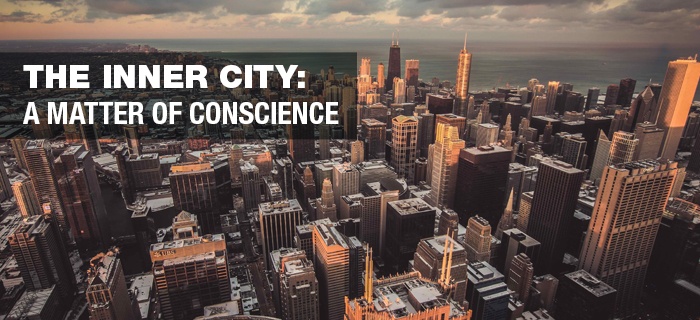
The city is here to stay. We cannot ignore, deplore, or flee it forever.
At the present time, ninety percent of Earth’s inhabitants live in five percent of Earth’s area. Within the next century it is claimed that 30 billion people may live in a universal city that covers the globe. Already the United States is a metropolitan society with at least 60 percent of its population clustered in the cities. In the cities, the future of America will be decided for better or for worse.
While the population of the cities mounts and continues, evangelicals, for the most part, are selling out and moving to the suburbs. For example, one Bible-believing denomination at one time had five churches within the city limits of a major city. Today it has one.
An evangelical withdrawal from the city has been taking place for many years. The body of Christ has further and furth estranged itself from the culture by developing separate but equal facilities in such things as schools, insurance, cruises, entertainment, retirement communities, book clubs, record clubs, and on and on. Now, in effect, we are building our own cities.
Evangelical Christians often equate their faith with nice people, blue skies, smiles, and upper class goals. In rural America, the Protestant is dominant—in fact, the conservative Protestant is dominant. Their attitudes and style of life set the tone for the whole society—the respectable standard—the American way, so to speak. But in the city, the Protestant is a distinct minority. Jews and Jewish values are influential. Roman Catholics outnumber Protestants, run far bigger church programs. By the time you add a sprinkling of multiple small sects from a melting pot of cultures, you come up with one sure thing: in the city, the Protestant style of life is not dominant.
This means that the evangelical who encounters the city does so with considerable cultural shock. The conservative Protestant feels uneasy about being a minority. One aspect of cultural shock is the feeling that you are trapped in a situation you do not fully understand.
The majority of evangelicals have long held an anti-city attitude, associating the city with Sodom and Gomorrah, scarlet women, crime, and filth. This “anti-urban bias” has kept us from penetrating three great areas of our world: Hinduism, Islam, and the modern city. Somehow we must come to realize that this attitude is suicidal to the church of Jesus Christ. A few months ago, I was visiting in one of the smaller cities of the Midwest. A fine, missionary-minded couple greeted me and took me in the hand almost immediately. They soon were extending to me their condolences for ministering in a city like Chicago (wicked, wild, and windy). “Pastor Sweeting,” they said, “the only sensible solution is to salvage your nucleus and move out.” I shuddered inwardly, and then patiently, and I hope, lovingly, told them of God’s concern for our city.
It seems inconceivable that at this point in the world’s history there are thousands of evangelicals who think like this.
Is this what we find in the New Testament? The apostles concentrated their efforts in the throbbing cities of their day. Many of the epistles stand today as evidence of the importance of the cities after whom these letters are named. The environment was not easy or compatible with the revolutionary new values introduced by the disciples of Christ.
Ephesus, located at the mouth of the Cayster River, was notorious for its luxury and moral looseness. Diana was the chief object of worship; and opposition to the Gospel was fierce.
Corinth, with a population of 600,000, was the largest city in Greece. The Corinthians were particularly prone to sexual promiscuity; enjoyed dragging each other off to court over any little difference of opinion. The city seethed with a mass of merchants, philosophers, ex-soldiers, and peddlers of vice.
Rome, the metropolitan center of the Roman Empire, was riddled with perversions, court plots, and murders. Its prosperity and immorality eventually brought about its downfall.
These were the centers of life where Christianity took root and flowered throughout the known world. The apostles went neither to the fringes of the towns nor to the tents of the migrants. They saw no future for the Gospel in isolation. They moved into the heart of the teeming cities—into the synagogues, the market places, the busy streets.
But what about the church today? Rather than bewail the evil influence of the city, yearning for a Christian rural past that will not return, we ought rather to face with zest the adventure of learning to live Christianly in a city-dominated culture. God did not give His Son because He loved the little cluster of people in the church, but because He loved the world, the adventure-seeking, reckless world where the action is.
John Goodwin, formerly with Inter-Varsity Christian Fellowship, writes, “Much of our drive to build separate but equal facilities (for use by evangelicals) is the desire to forget the war we are in. We can’t forget it very well with drunks stumbling at our feet, so we go to ‘Christian’ hotels. Non-Christians upset us, not so much because they curse and carouse (we have worse sins of our own), but because they remind us of evaded responsibility. From time to time, this guilt gets intolerable (down deep we do love Christ), so we mount our chrome-trimmed chargers, and like knights of old, gallop out of our castles in search of the dragon. We usually find him in jail, or a skid-row mission or other captive audience (even a fraternity?) where we can dump our Gospel load and get out again with a minimum of personal involvement or time wasted. Then back to the castle we tear, mission completed. With the drawbridge slammed shut behind us, we sing ‘Safe Am I’ and settle down again. Often our castle is psychological, but none the less is real.”
Jesus prayed, “I pray not that thou shouldst take them out of the world;” yet what Christ did not want the Father to do, we are doing ourselves when we withdraw. We try to create a monastic existence in order to avoid temptations and to live a more godly life, but this is a foolish underestimation of the devil’s wiles, and perversion of the Great Commission.
Holy Optimism Necessary
What then is to be the approach of the city church? First of all, we need to look at our attitudes concerning both God and the city.
If we are to reach our urban age, we need to cultivate an attitude of holy optimism. I am an optimist because of the sovereignty of God; surely not because of myself. Paul expresses this attitude in several places; for instance, “If God be for us?” (Romans 8:31). Alone we can only be dragged into the mire of the city. The city exposes and bruises, and tears us; but much of what the urban culture uncovers in us is sick and needs to be laid before the healing power of Jesus Christ.
The apostolic church faced mountainous problems with complete confidence in God. “God is able” was their password into pagan territory. Only a fool would have attempted what they did in mere human strength. Problems? Yes, they had problems. We will have problems. Each of us faces his own little custom-designed set of temptations, of problems. And as we enter the world of the city, we have individual areas of vulnerability which need to be exposed continually to the help which comes only from God Himself.
True, the more we insert ourselves into the world, the more we encounter the agents from the headquarters of evil. If we are to “go” into the world, we must accept the fact that there is no point in hiding our eyes and hoping the enemy will go away. It becomes more apparent to us here that we have to face him and take him on—but we also know that we have access to a power greater than the evil one. We have Christ in us. He is our hope. When we step into the city without Him, we are asking to be knocked out. Jesus Christ is the only adequate shield.
We at The Moody Church are thrilled to be located in the heart of our great city. Our facilities are excellent. We have been placed here by God, and by His soldiers of the past generation. Our roots go deep into the history of Chicago. We have a divine assignment to the burgeoning city, and we are optimistic about staying here because we know that Jesus Christ guarantees our victory.
In addition to our optimism about the sovereignty of God, we evangelicals need to work out a positive, rather than negative image of the city. Protestantism has somehow inherited a false perspective which says, “God made the country; man made the city.” Even the names of many churches bear this out: Pleasantdale Community Church, Brookside Baptist, Shady Rest Presbyterian, Mountainside Methodist. Sometimes we get so restful that we give the impression of a cemetery. We smile and nod and avoid the closeness within our fellowship that discloses flaws and problems and conflicts. The appearance from the outside may very well be one of living in a trance, a dream world—where life is unreal.
We imply by our retreat that we can find God in nature, and we do need to withdraw occasionally even as Christ Himself did—at the ocean, or the lake, or in the mountains. But we imply by contrast that God has withdrawn from the city and left only a pit of snakes. We picture the city in our minds as only a demonic assortment of hippies, prostitutes, junkies, gangsters, pool halls, slums, and vice dens.
But what about the architectural beauty that lies in the old sections of the city? What about the fascinating ethnic atmosphere of whole sections of a city? What about the gold in the mire? What about the vigorous spirit in the children who have not yet been crushed by intolerance and greed? What about the beauty of the Gold Coast at dusk or the traffic arteries from Marina Towers? Or the interesting people walking down the avenue?
I like the cadence of the jackhammer. I like the sight of a huge crane hoisting steel beams into place. I like the flow of concrete, the clacking of a million heels on finished pavement. Here is action; here is life. In the crush of multitudes, the power of the living Lord can still be sensed.
Let us not limit our spiritual experience to the Grand Canyon. May God burden us for the cities of our modern world. The Gospel is for all. The figure of Christ was most commonly seen in the press of the people.
Maybe we need, first of all, to become convinced that we all are the same inside, no matter how differently we may appear on the surface. James pictures two men in chapter two of his epistle. One man wore a gold ring and fine clothes. The other, obviously poor, arrived in shabby dress. The short-sighted usher had made class distinctions in his mind before he ever got into this spot. His quick disposal of the problem at hand placed the well-dressed worshipper in an excellent seat, and the poor man he told to sit on the floor or stand up!
The inclusive Gospel cannot be shared by exclusive people. To label people as worthy or unworthy, as good and bad, as acceptable and repulsive, is not consistent with the grace of God. In Jesus Christ there is neither Jew nor Greek, bond nor free, male nor female. Classicism and racism are insults to God. Both are anti-Christian. Every man, regardless of outward differences, is made in the image of God.
Redemptive Work Needed
The church, particularly in the city, must remain a bulwark of God’s saving power to all. It must unite a redemptive work with the redemptive Word of God. Some months ago, I visited an eighteen-year-old in jail. His parole officer asked me to help him secure a suitable job for the young man. I talked several times with Sandy about the power of God to change his life, and also about his resuming his place in society. We found him a job, and then he responded to the call of Christ in his life. Then I asked him if this was the first time he had ever heard the Gospel. He shocked me by answering, “Oh, no, Pastor Sweeting, I’ve heard it a thousand times. But this is the first time that anyone showed me that they cared what happened to me.”
Sick of words. Dying for a personal demonstration of the love and power of the sovereign Lord. What kind of redemptive work can we bring to the city as we unite our actions with our witness? This redemption could take the form of reading classes for children; tutoring sessions for students; classes for the [challenged]; language help for the immigrant; employment service for the poor; Christian counselling centers for the disturbed; golden age clubs for the elderly.
All these are earthly demonstrations of an eternal faith in the love and grace of our heavenly Father. We here at The Moody Church were founded by Dwight L. Moody, one of the most dynamic men of the nineteenth century. I firmly believe that if Moody were alive today, he would be leading us in imaginative ways to help the poor value themselves, to search out the problems of the needy, to educate and lift the minority groups with the ultimate purpose of winning them to Christ.
When Dwight L. Moody was asked why he had organized the school that later became Moody Bible Institute, he said that, besides training students in the knowledge and the use of the Bible and in Gospel music, he wanted to train them in everything that will give them access practically to the souls of people, especially the neglected classes. (Bernard DeRemer, Moody Bible Institute, A Pictorial History, Moody, 1960).
This is in no way an endorsement of the social gospel as we have seen it displayed without a concern for individual salvation. Rather I am pleading for our Christian awareness of the practical day-to-day needs of people as we also share with them what Christ can do. We do this on the mission field, but not in the apartments at our back door.
The city congregation everywhere must carve out new patterns of ministry—in the slums, among the hippies, in the arenas of commerce, in the seclusion of apartment piled on apartment. The church of Jesus Christ must reach behind the walls of steel and concrete to bring the touch of love that can change water to wine!
Our God is still alive! It is in His power alone that we evangelicals can invade the cities of this age. Let us be optimistic about the sovereignty of our God. Let us be perceptive about the tremendous resource that is buried in the city’s people. Together these attitudes can set off an explosion of love that will be the reformation of the late twentieth century.
But we must GO! And we must go humbly, ready to learn as well as to teach, ready—if necessary—to lay down our lives.