 Sign In
 Store
Store

D.L. Moody As I Knew Him
By | Originally published September 19, 1926
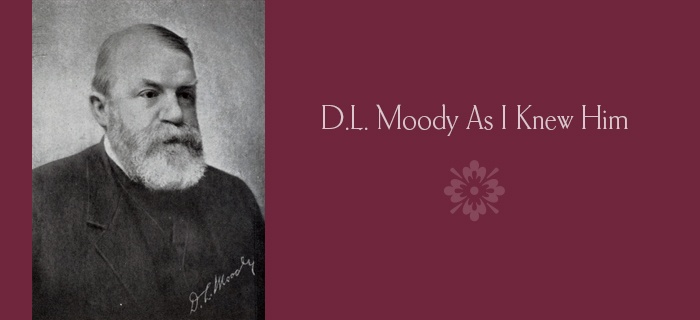
The Moody Church was honored with the presence of Dr. F.B. Meyer of London, England, on Sunday afternoon, September 19, 1926, at which time he gave a special address to pastors, Sunday-school teachers, and Christian workers. Preceding that message, Dr. Meyer gave several reminiscences of his early association with Moody and Sankey. The following are excerpts from his remarks, stenographically reported, and not corrected by the speaker.
I am very glad to see you and I want to tell you two or three things about my early knowledge of Moody and Sankey. I was sitting in my study one Saturday in June, 1873, preparing for the following day, when a messenger came in with a telegram. It was to the effect that Moody and Sankey had just arrived, and added, “Shall we come on?” Mr. Moody had been in London the previous year, 1872, and had come over to our city for only a short time and had made a few friends. This telegram awoke my heart. We telegraphed him to come, and that afternoon Moody and [his] wife and two children and Sankey and [his] wife came on to my church.
You understand that in the previous year they had been invited by a clergyman in the Church of England, and another gentleman, to come to London and they would see after him. But on his voyage across the Atlantic each of these men died and when he reached Liverpool two telegrams were put into his hand, stating the facts. Standing there and walking up and down, Moody said to Sankey, “I guess God has shut the door there and if so, we must go home.” Then suddenly he thought of York, telegraphed to me, and came on. I shall never forget Moody’s first Sunday in my church!
Filled With The Holy Spirit
Then I remember one summer morning sitting with Moody in his home (I went there ten or eleven times from England) and he told me this. He said, “I opened a hall on Sunday nights for everybody and the place used to be crowded every Sunday. Four old ladies sat right in front. (One of them died only a few months ago.) They used to sit there and say, ‘Very good, very good, Mr. Moody, but there is something you haven’t got.’ I never quite understood what they meant until one day I was going along Fifth Avenue, New York, and God seemed to come very near and I felt I must get alone. I knew a man living on the avenue and I went to him and said, ‘I want to have a room to be alone.’ To humor me, the key was given.”
Moody told me that he first sat on the sofa and God came very near to him. Finally, he found himself on the very floor, entreating God to fill him with the Holy Spirit. This is almost too sacred a story to tell and yet I tell it to you because there are men and women listening to me who need to know that there is a face to face contact with the Eternal. I remember Moody saying, “I would rather give up my right hand any day than to have missed that experience.” He told me that the next Sunday, when he came back to Chicago, the old ladies in front were laughing and crying together and they said, “Oh, Mr. Moody, you have got it now.”
Some people may hear me speak now who have done just that and have gone back on it. You have been married to Christ and you have been playing the fool and you must come back and be restored.
I had in my church a very old woman who took my young women’s class. When she heard the story I have just told you, she spent the interval between the morning service and the afternoon school in prayer and fasting. I said to her at five o’clock, “How have things gone?”
“Oh,” she said, “I have told that Moody story again and I believe every one of my girls has given her heart to God.” To me that meant everything.
I had been brought up in a holy home. I had been in business for a little. I had taken my degree in college and yet I didn’t know anything about conversion. I owe everything in my life to the enquiry room where, for the first time in my life, I found people broken hearted about sin. I learned the psychology of the soul. I learned how to point men to God. I don’t know how ministers today live without that college of experience.
Moody Finds Sankey
I want to go on to a rather amusing thing. Mr. Moody met Sankey at Indianapolis. One Sunday afternoon Mr. Moody was having a conference and the young musician who was to play for the service did not appear. Sankey at that time was in Civil Service, earning a fine salary. The people saw him at the meeting and asked him to take the organ, which he did. When the meeting was over, Moody went to him and said, “You have got to come along with me.”
“But I can’t; I have a fine position. I can’t give that up.”
“Well,” said Moody, “this is Saturday afternoon. I will give you until Monday evening to make up your mind. But you have got to come.”
So Sankey asked the Almighty about it. He was a good man, a lovely man—was Sankey. Some of us who remember Moody will remember the falter in his voice when he was pleading with men to come to God. Sunday night, Moody was on the street preaching with wonderful power. Sankey was so overcome as he listened that when Moody went up to him at the end of the service and said, “Well, man, what is your verdict?” Sankey said, “I will give it all up, and come along.” From that moment those two men were brothers. There was many a joke about their brotherhood.
A Mr. Rees, who was then in Southerland, not far from York, wrote to me and said, “I hear you have got two Americans along with you. I like what I hear about Moody, but I don’t quite like what I hear about Sankey.” You know we had no solo singing in those days.
So, I said to Sankey, “You have got to go over and see Mr. Rees,” I think he was more nervous about singing for him that for the Queen herself. When he got to Southerland, Mr. Rees met him and took him to a butcher shop where Mr. Rees, the butcher, and the butcher’s daughter formed themselves into a committee and they said, “Sing.” So Sankey sang, sitting at the little organ. And the judges said, “That’s good. Sing another.” So he did. Finally they said, “You will do. Come along.” That night at the depot Sankey said to me, “It’s all right; I’ve passed.”
History Of A Great Song
Of course you have heard the story of how the music to the song, “The Ninety and Nine” was written. Sankey was a lovely man. People were so taken up with Moody that they hardly realized the beauty and glory of Sankey. They had gone to Glasgow and coming home the next morning. Moody was reading a Gospel paper and saw in the poem, “There were Ninety and Nine.” He passed it over to Sankey and said, “I think there is something here that will suit you and when I preach on the Twenty-third Psalm, I am sure you will get something out of this that will fit nicely.”
So Sankey put the poem in his pocket and thought no more about it. When he reached Edinburg, Moody started to preach on the Twenty-third Psalm and he turned to Sankey, when he had finished, and said, “Mr. Sankey will sing The Ninety and Nine.”
Sankey turned hot and cold. He had no song. He put the words in front of him as he sat at the little organ and note by note the tune was given to him, though he said in London that he was in mortal fear lest he would not sing the second verse by the same tune that he had sung the first.
Moody Won The Students
They went to Glasgow and on the last night two or three thousand came to the inquiry room. They went to Manchester, to Liverpool, to Oxford. The students there were not very fond of what they heard about Moody, because they were rather highly educated and they were not going to be exhorted by this man with only an ordinary education. The first night at Cambridge they shouted and laughed and played with him. For the first time in his life, it seemed they had beaten him. But they were real good fellows and when they got home they thought they had acted rather badly and they went to apologize. Mr. Moody said, “I am very glad you have come to apologize. I think I deserve it. But anybody can make a apology. I want to see how deep your apology goes. If you mean what you said, all of you who acted like rowdies last night must sit like lambs in front of me tonight.” And they did. He had a great crowd and he held them in the hollow of his hand and out of that company came a group of men who have lit the torches around the world. I wish that I might see before I pass home a group of men like that, filled with the power of God, yet a highly educated group—men to whom the world shall have to listen.
Preaches To Royalty
After they had been for a year or two in Britain they came to the Andrew Carnegie Hall—using the hall in the morning, the Opera House holding 2,000 of London’s society, the royal ramily occupying boxes, in the afternoon, and the Agricultural Hall with 20,000 seats at night. At first London did not at all take to these two men, but outside the Agricultural Hall there would be a motley crowd of men and women turned away. I am sorry to say that our newspapers did not understand the movement. They could not distinguish between the messenger and the message. They did not realize that God had set the hearts of these men on fire with His Holy Spirit. For after all, you know there is something more than intellect in the world. Behind the intellect there is the spirit—the mighty Holy Ghost—and when He grips a man He lightens up his mind.
All Men Equal
The newspaper men did not understand that until the highest man in the realm, the High Lord Chancellor, noted it. Clergymen and ministers thronged the platform, but Mr. Moody did not make much of these. There is one amusing story of a lord coming in one day and somebody saying, “Oh, Mr. Moody, there is a Lord So-and-so.”
Moody turned to the man and said, “You see those two old ladies in the aisle? I wish you would get a chair for them.”
London came to him—came into his hands. The power of God spread through that city, and this happened. A friend of mine, and old man now, told me this. Gladstone, one of the greatest Christians we have ever had, a great wonderful leader, marvelous orator, a man who would not allow anything to interrupt his enjoyment of Sunday which he spent with God—on one occasion, Gladstone sat on one side of my friend, and Matthew Arnold on the other. The latter was one of the greatest critics of his time. When Moody was through, Gladstone held out his hand and said, “I thank my God I have lived to hear the Gospel preached as that man preached it today.” And Matthew Arnold said, “Mr. Gladstone, I would give my hand any day to be able to believe as confidently as that man believes.” Marvelous testimony from two of the most brilliant intellects.
I wasn’t here when Moody died. I believe I came the second year after he passed away. He died suddenly, as you know. I was preaching in Brooklyn when Sankey was on the point of death and I came across one Sunday afternoon to see him. I will never forget it. I found Sankey lying there, evidently at the end. He was quite blind. His lovely, beautiful face was lighted up, and there he lay. His wife was sitting there fanning him and I took his hand and we talked and talked about that memorable past and I suppose in heaven I shall resume that conversation.
Finally, I arose to go, but he said, “You can’t go till I have sung for you.”
“My dear man,” I said, “you can’t sing.”
“Oh, yes, I can.”
“There will be no dark valley when Jesus comes,
“To gather His loved ones home.”
He sang the four verses of the hymn, and then I leaned over and kissed him and said, “Goodbye, Sankey, there will be no dark valley for you, and I trust there will be none for me.”