 Sign In
 Store
Store

The Three Crosses
By | Originally published 1936
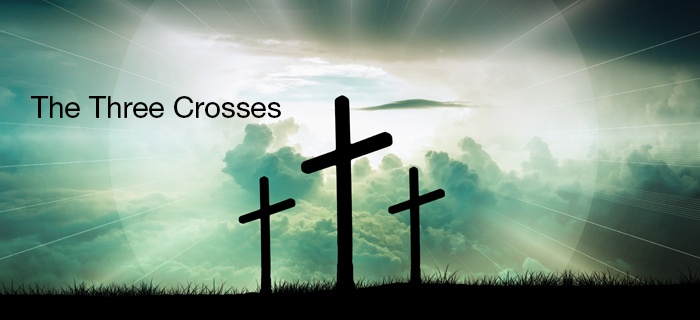
You will find my text in the Gospel as recorded by Luke, chapter 23, and at verse 33: “And when they were come to the place, which is called Calvary, there they crucified him, and the malefactors, one on the right hand, and the other on the left.”
Upon that hill lone and gray, outside of the city wall, three crosses stood. Upon the center cross the King of love died and on the other two there were thieves, perishing because of their iniquity. Seeing that these three victims died together it seems to me that these three crosses speak of three relative truths the Lord would have us consider together.
As I look at those three crosses, I see one man dying in sin and another dying for sin and another dying to sin. The two thieves had sin in them; Christ had sin on Him. Thus you have a dying saint and a dying Saviour and a dying sinner. Or, may I put it in this way: Those three crosses speak of three outstanding things facing every one who is brought into contact with the truth of the Gospel. The cross upon which Jesus died is The Cross of Redemption. The cross upon which the dying thief perished and who, as he died, believed the message of the dying Christ can be called The Cross of Reception. The other cross upon which the thief died even as he lived, can be called The Cross of Rejection. So we have The Cross of Redemption, The Cross of Reception, and The Cross of Rejection.
The Cross Of Redemption
First of all, then, there is the central cross, the cross of Jesus, The Cross of Redemption. We take this first because it is indeed the greatest of the three. The cross of the Lord Jesus is the central point in history. The three great focal events in time are creation, crucifixion, and the coming again of our Redeemer. Crucifixion, the punishment that was meted out to slaves and criminals by the Romans, was abolished by King Constantine. As meted out to the Lord Jesus, the Holy One, it forms the darkest blot upon the pages of human history for the cross of the Lord Jesus is not only the culmination of the revelation of the love of God, but the culmination of the hatred of man against God’s beloved Son. Now we look upon the cross as an ornament; we use it to decorate our churches. Ladies and gentlemen wear a golden cross as a thing of beauty. It is suspended from the necklace or the watch chain, but in the day of our Lord, the cross was a symbol of shame even as the gallows are in the land I represent and as the electric chair is in this great land of yours. But there stands the red and rugged cross of Jesus.
The heart of Christianity is the Bible, and the heart of the Bible is the cross of Christ, and at the heart of the cross of Christ you have the very heart of God Himself. That middle cross, The Cross of Redemption, speaks to me of one or two fundamental things of Holy Writ, namely, of a law that has been fully satisfied, of a love that has been truly manifested, of a liberty eternally secured, and of a life that must be daily lived. A word or two regarding each of these.
- First of all, the cross of Christ speaks to me about a law that has been fully satisfied. Jesus, by His death, met and discharged the exacting, awful demands of the law. The Mosaic law hated sin, condemned the sinner for his sinning, and left him to die. The law demanded death. Having pronounced the curse upon the sinner, it could impart no life whatever. Thus it is, “Cursed is every one that continueth not in all things which are written in the book of the law to do them” (Galatians 3:10). But there on the cross, the Lord Jesus removed the curse pronounced by the broken law, “Cursed is every one that hangeth on a tree” (Galatians 3:13). Thus the Lord Jesus fulfilled the claims of a broken law and died in our room and stead. We should have died for our sin, “The soul that sinneth it shall die” but,
“Bearing shame and scoffing rude
In my place condemned He stood
Sealed my pardon with His blood;
Hallelujah! What a Saviour!”
And now the Christ who died on that cross has by His death removed the curse and the cross becomes the charter of my pardon, intimates my acceptance with God and my heirship into the glories of the household of God. And as I look at that center cross, I am enthralled in glad bondage to my Redemeer; being freed from the curse of the law, I am inlawed to Christ by His cross. I have become His love-slave forever and what else can I do but utterly abandon myself to Him who, in His condescension, became my substitute, my sin-bearer.
“Love so amazing, so divine,
Shall have my soul, my life, my all.”
- And then that Cross of Redemption also speaks to me of a love that has been truly manifested. Calvary causes me to believe that God loved me without stint or reservation, that He cared for me so passionately as to give the Son of His bosom that my miserable soul might be saved from sin. So, inscribed on the cross we see in shining letters, “God is love,” and nowhere else in the universe can you learn the truth of God’s love. Nature has nothing to say about the love of God toward a world of sinners lost. I look out upon the majestic sea; I gaze up at the starry heaven and I am reminded of the skill and of the power of the Almighty, but nature is silent regarding the love of God to men and women who are down in sin and need deliverance. Calvary is the only school in which we can learn about divine love, and that is why the old divines referred to the cross as “the academy of love.” My friend, if you are doubting the love of God, I beseech you to wend your way home after the meeting and in silence bow before the bloodstained Man of Calvary, and as you look up into His face, realize that He was but revealing to men and women in their sin the great heart of God. It was the vision of the dying love of the Redeemer that melted my heart of stone and led me into willing captivity.
- Again, that middle cross speaks to me about a liberty that has been eternally secured, of the power of Satan and of sin and of the world forever broken by His death.
“There is power, wonder-working power,
In the blood of the Lamb.”
So we join in the doxology of the apostle Paul, “Unto him that loved us, and loosed us from our sins in his own blood” (Revelation 1:5).
I have a friend in the city of Glasgow who many years ago found himself in Barlinnie prison because of his sin. He was given to drunkenness, became a sot, and grieved the heart of his godly mother. After serving his term of imprisonment, he found his way back again to the old home, and the mother who loved him pled with him to sign the pledge. But, like the honest man he was, he said, “No, mother, I have signed enough pledges to paper the wall; I need something more than a pledge.” But she said to him, “Sinclair, perhaps if you sign it this time it may help you,” and, having a pledge near at hand, she urged her wayward boy to sign the paper. But again he said, “No, mother, I am not going to sign another pledge. I need a power that can make me a sober man and change my life.” Growing desperate his mother took a knife and opened one of her veins and dipping a pen into her flowing blood she said, “Sinclair, sign it with your mother’s blood and that may help you.” I heard him say one night before a crowded audience, “What the blood of my mother could not do, the blood of Jesus Christ accomplished,” and that man tonight in Glasgow is preaching the Gospel of the Redeemer. I want to say this to you this evening, no matter how far you have traveled from God, no matter how that life of yours has been stained by iniquity, the blood of Jesus Christ, God’s Son, can cleanse you from all sin. And I have seen too many bleeding hearts restored to doubt the efficacy of the shed blood of Jesus.
- But then as I look at that center cross yet again, I realize that it speaks to me of a life that must be daily lived. Paul speaks about being “crucified with Christ.” It is one thing to believe in a crucified Christ, a different thing altogether to live the crucified life. Are you dead to the world? Is the world dead to you? As a Christian do you see yourself nailed with Jesus to that cross, for The Cross of Redemption speaks to us of a life that must be daily lived.
The Cross Of Reception
The next cross is The Cross of Reception, the cross upon which that dying thief realized his need and grasping the opportunity came to know something of the power of Christ to save. I sometimes wonder on what side of the Cross of Redemption the Cross of Reception stood. I think it was on the right side of Christ for the psalmist speaks about God saving by His right hand. Let us look for a moment at this second cross where you have the first fulfillment of our Lord’s own word, “I, if I be lifted up from the earth, will draw all men unto me” (John 12:32). Christ is lifted up and for the first time a man is drawn to Him and that man became the first trophy of the blood of Christ, the first one to enter paradise through the sacrifice of the Redeemer. And now that man illustrates the saved sinner. In the morning he found himself in a state of nature, at the noontide hour in a state of grace, and at the midnight hour in a state of glory. As I look at that Cross of Reception, I realize that Jesus was exercising His threefold office as Prophet, Priest, and King. As the Prophet, He said to those weeping women, “Daughters of Jerusalem, weep not for me, but weep for yourselves, and for your children, because of the days that are coming.” As the Priest, He cries, “Father, forgive them; for they know not what they do,” and in dying anguish, “It is finished.” But as the King, He carried the key that opened the door of paradise for the believing soul to enter.
Let me tell you of two things I learn as I look at the Cross of Reception: the triumph of faith and the triumph of grace. There is the triumph of faith for that dying thief who rejoiced to see that fountain in his day was saved by a naked faith, faith apart from any ordinances. I do not despise the ordinances; I believe in baptism and in the Lord’s Supper, and had that man lived, he would have confessed Christ in the waters of baptism and remembered the Christ who died in his room and stead, but the blessed Lord took the will for the deed and that man was saved by a naked faith. He cried, “Remember me when thou comest into thy kingdom,” and our Lord’s loving reply was, “Today shalt thou be with me in paradise,” and out he went not into any unconscious period, not into any purgatory, but with his Lord into paradise. “Absent from the body, present with the Lord.”
Then you have the triumph of grace. There is no limit to the mercy of God. “Whosoever will may come.” That man was a thief, he was also a murderer, and yet although his hands were stained by human blood the blood of Jesus obliterated the stain. Let me draw a bow at a venture. There may be a would-be suicide here this evening, there may be a murderer, there may be a thief, there may be a harlot, a libertine, but if you sit there with your soul stained with the blackest sins of hell, I am here to tell you that because of the grace of God reflected in the finished work of Jesus your past can be blotted out and you can be saved.
“His blood can make the vilest clean,
His blood avails for me.”
But think of the triumph of grace in this respect. That man was saved at the eleventh hour, nay on the stroke of twelve his precious soul came to know the life-giving power of the Christ dying at his side. Saved on the stroke of twelve! Yes, Christ holds on to the very last, loath to let any sinner slip into a lost eternity. Thus, “While the lamp of mercy burns the vilest sinner may return.”
Sometimes I am asked if I believe in deathbed conversions. Of course I do. What else can I do but believe that men and women can be saved as they reach the great dividing river, when I read the story of the dying thief? The grace of God is so remarkable and marvelous that if men come with the rag tags of a wasted life in the last hour, He will receive the returning sinner. “Him that cometh to me I will in no wise cast out” (John 6:37). But, my friend, do not go away saying, “Well, if God can save me at the end, I will have my fling; I will live for the world and the gratification of my own sinful desires and passions and when I find myself on a deathbed, I will send for a minister and repent and at the last, find myself in eternal bliss.” What a mean thing to trust to a deathbed repentance. You may never see a deathbed, for this old Book says, “He that being often reproved hardeneth his neck, shall suddenly be destroyed, and that without remedy” (Proverbs 29:1). How dare you talk about a deathbed when your breath is in your nostrils and God may withdraw it at any moment? You may come to the end bereft of reason and of consciousness, incapable and altogether lost as far as understanding the truth of the Gospel is concerned. Your last hours may be unconscious ones, doped by the opiates of a doctor that you might not feel the pain and anguish of those last hours. Some of my saddest moments have been those when I have stood alongside of the dying and because they were drugged or in a state of coma I could not urge them to flee to Christ for deliverance before the silver cord was loosed. The triumph of faith, the triumph of grace! Let me urge you who are young and strong and free not to be so mean and wretched as to give the best of your life to the world and the devil and then come with the rag tags of a wasted life at the end of your days and then think that God will be satisfied.
The Cross Of Rejection
Then you have the Cross of Rejection! How dark! Oh the tragedy of dying without Christ. Look at those three crosses again. Only one was saved that none might despair, but only one that none might presume. From one side of the Cross of Redemption one man goes to paradise, from the other side a man goes into perdition. The cross divides the men. There you have enacted a universal law. The Gospel is either the savor of life unto life or death unto death. Think of it, the same cross, the same terms, the same day, the same opportunity, yet different responses. One man receives, the other rejects. And the preaching of the cross is either “the power of God unto salvation” or it seals the doom of those who willingly reject all that God offers in the person of His Son.
I do not know but possibly those two thieves were brothers, born into the same home, dangled upon the same mother’s knee, growing up and passing out into life beginning in simple ways to trifle with life and opportunities, and then drifting into sin found themselves companions in iniquity and now companions in the death they were dying for their sin. Yet one brother believes and passes out into paradise; the other brother rejects and departs into everlasting woe. Does the cross divide your home? Some in your home are on the Cross of Reception, having received Jesus, but you, the only one unsaved, you are responsible for that broken home circle, still on the Cross of Rejection. Yes, the cross divides men. I cannot tell you how it is but it is a fact of nature that the same sun streaming down has the power to melt the wax and at the same time harden the clay. The same breath leaving this mouth of mine can warm these hands on a cold day and yet is able to cool a vessel of hot soup. The same Gospel preached here tonight will lead some to repentance, others will go out hardened because of their unbelief, and the cross will be the dividing factor.
There are also two things I learn as I look at that Cross of Rejection. The thief who died in his sin wanted Christ without the cross; and he died with the remedy for his sin at hand. God give me strength to emphasize these two thoughts! That man wanted a Christ without the cross; for it was he who said, “If thou be Christ, save thyself and us” (Luke 23:39). He wanted Jesus to come down from the tree and thereby prove His authority as the Son of God. He was a modernist; he wanted an unbloody Christ; he wanted a Christ without the cross; he wanted a bloodless cross, but we have no Christ apart from the cross on which He died for Christ and His cross have been eternally nailed together. Paul said, “We preach Christ,” and modernism stops there. Modernism preaches Christ, preaches the ethical Christ, the social Christ, the lovely Christ, the beautiful Jesus, but Paul said, “We preach Christ and him crucified,” and we have no Jesus to preach save the one who was bespattered with His own gory blood, the One who was willing to be nailed to a tree that we might be saved from our sin and everlasting contempt. The moment this church departs from the preaching of a crucified Christ, its power for God will depart. He wanted a Christ without a cross; that is why our churches are half empty and the world is becoming more pagan. Our pulpits are manned with men who have nothing but a bloodless gospel to give to men and women in their need, whose hearts are hungry to know something of the red blood of Jesus that can make the black heart of the sinner whiter than the snow.
And then, he died with the remedy for his sin at hand. He died as he lived, unsaved, passed out with the cross on his conscience and the vision of that blood-stained Man on that middle cross to haunt him through the countless ages of eternity. Think of it, it was impossible for Jesus to be nearer to the man than He was. As near to the one man as to the other, and yet he went out into a lost eternity with the very remedy for his sin at hand. And what else can the Lord do for you? Remember that there are men and women in a lost eternity this evening who once sat where you may be sitting, but they passed out into eternal darkness with the very remedy for their sin at hand.
Think of the opportunities you have of fleeing from the wrath to come. You live in a land of Christian light and liberty, in a land of churches, in a land of Bibles, in a land of religious liberty. Here you are tonight in this God-honored church [The Moody Church] and the Spirit of God brought you here. Whether a friend invited you or not, at the back of all circumstances there was the prompting of the spirit of God and He is here dealing with you in the silence of your soul. Somewhere in the building is a friend praying that you might be saved; “angels hovering round to carry the tidings home,” and the preacher is seeking with all the power of his ransomed being to urge you to flee to the Man on the middle cross who died for your sin. God has exhausted Himself; He can do no more, and if you die in your sin, you die with the remedy at your hand. There is some excuse for the heathen in their ignorance and blindness who have never heard the story of Jesus, who know nothing of the Gospel, who serve God as He is revealed in nature, who in their blindness bow down to idols of wood and stone. I say, some excuse for them but none for you. And I want you to know from my lips this evening that there is no sin so black and nothing so callous as the definite refusal of the Christ who alone can save.
Are you lost? Are you on the Cross of Rejection? Have you the realization that from day to day you have been rejecting the Lord Jesus? Then hurry to the cross for cleansing. Let there be a transfer of crosses tonight. You entered this church on the Cross of Rejection, may you be found on the Cross of Reception. “But as many as received him, to them gave he power to become the sons of God, even to them that believe on his name” (John 1:12). See yourself on the middle cross in the person of Jesus and through receiving Him as your Saviour, pass out with the assurance that the past has been obliterated, that the Holy Ghost has entered, and that when you reach the end of your earthly pilgrimage, paradise will be your everlasting portion.